
Walk into any bar, restaurant, gift shop, or promotional products showroom in the United States, and you’ll find shot glasses doing more work than their size suggests. They’re small, but they carry big margins, strong brand visibility, and surprisingly complex sourcing decisions for anyone buying in volume.
For importers, wholesalers, and brand owners, choosing the right shot glass isn’t just about picking a shape off a catalog page. Size tolerances, glass composition, printing method, and packaging all affect breakage rates, customer satisfaction, and reorder profitability. A wrong decision at the sourcing stage can mean returned pallets, inconsistent branding, or a product that simply doesn’t perform on a bar shelf.
This guide covers everything a serious buyer needs to know: what a shot glass actually is, how sizes and materials vary, the manufacturing process behind them, and how to evaluate a supplier for OEM or ODM production. Whether you’re stocking a hospitality supply catalog or launching a private-label spirits brand, this is the reference to work from.
What Is a Shot Glass?
A shot glass is a small drinking vessel designed to hold and measure a single serving of spirits, typically consumed in one swallow. According to authoritative Dictionary Definitions of Barware, shot glasses are built around precision — their volume is meant to approximate a standard liquor pour, which makes them as much a measuring tool as a drinking glass.
Bartenders use shot glasses to pour consistent, repeatable measures behind the bar, which keeps drink costs predictable and recipes consistent from one bartender to the next. Beyond the bar, shot glasses show up as souvenirs, promotional giveaways, wedding favors, and collector’s items, which is part of why the category supports such a wide range of custom printing and novelty designs.
Standard shot glass measurements in the U.S. typically fall between 1 and 1.5 fluid ounces, though sizes vary by region and by the specific pour a bar or brand wants to standardize. For a broader historical perspective, industry experts at A Bar Above’s Guide to Bar Equipment note that these variations have deeply shaped global drinking cultures over centuries. We’ll break down these measurements in more detail in the sizing section below.

The History of Shot Glasses
The exact origin of the shot glass is debated, but most drink historians trace small-format spirit glasses back to 17th and 18th century Europe, when whiskey and gin were commonly served in small vessels to control portioning. Some accounts point to glassblowers cutting down broken glass stems into miniature cups, giving rise to informal “shot” measures long before standardized bar tools existed.
By the 19th century, distilleries and saloons in the United States had adopted small glass tumblers as an informal standard for serving whiskey, and the format became closely tied to American bar culture. Prohibition-era speakeasies and post-Prohibition bars continued the tradition, cementing the shot glass as a fixture of American drinking establishments.
Today, the shot glass has expanded well beyond the bar. It’s a staple of the souvenir and promotional products industry, a common vehicle for brand marketing, and a popular collector’s item, with tourist destinations, sports teams, and events all producing their own branded versions. This evolution from a simple measuring tool to a broad merchandising category is exactly why customization and OEM production have become such a significant part of the shot glass market.
Common Shot Glass Sizes
Shot glass capacity is one of the most misunderstood aspects of the category, partly because “standard” sizes differ by country, bar culture, and even state liquor regulations. For wholesale buyers, understanding these differences is essential to sourcing the right product for a specific market.
The most common capacities found in U.S. and international markets are:
*1 oz (30 ml) — The most common U.S. bar-standard pour, widely used in casual dining and nightlife venues.
*1.25 oz (37 ml) — A slightly larger pour used in many U.S. states as the default “standard drink” measure.
*1.5 oz (44 ml) — Often called a “jigger” pour in the U.S. This exact volume directly aligns with the official definition of a National Institutes of Health (NIH) Standard Serving for Distilled Spirits (which explicitly defines a 1.5-ounce shot of 40% alc/vol distilled spirits as one standard drink)
*2 oz (59 ml) — Popular for novelty and double-shot glasses, as well as in some European markets.
| Size | Volume (oz) | Volume (ml) | Common Region / Use |
|---|---|---|---|
| Small Shot | 1 oz | 30 ml | U.S. casual bars, promotional glasses |
| Standard Shot | 1.25 oz | 37 ml | U.S. state-standard pour, restaurants |
| Jigger Shot | 1.5 oz | 44 ml | U.S. cocktail bars, hospitality |
| Double Shot | 2 oz | 59 ml | Novelty glasses, some European markets |
Regional differences matter for export-focused buyers. In the U.K., a licensed “single” measure is typically smaller and legally regulated, while in Australia, standard pours are often calibrated closer to 30 ml. Buyers sourcing for multiple markets should confirm local serving-size norms and any labeling regulations before finalizing an order, since a glass that’s compliant in one country may not match expectations in another.
Different Types of Shot Glasses
Shot glasses aren’t a single uniform product. The shape, wall thickness, and base design all affect durability, printing surface, and how the glass performs in a commercial setting. Here’s a breakdown of the most common types manufacturers produce for wholesale and custom orders.

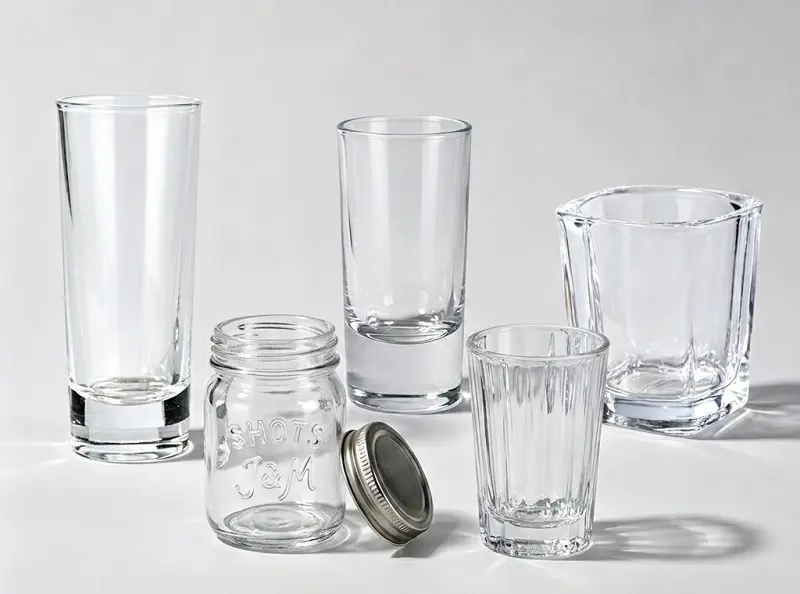
Standard Shot Glass
The classic straight-walled cylindrical shot glass is the most widely produced style, and for good reason — it’s simple, stackable, and cost-effective to manufacture at scale.
*Description: A simple cylindrical glass with straight or very slightly tapered walls.
*Best Use: General bar use, promotional giveaways, retail multipacks.
* Advantages:** Low production cost, easy to print on, stacks well for shipping.
* Typical Capacity: 1–1.5 oz.
Heavy Base Shot Glass
Built with a thicker base for stability and a more substantial feel in hand, this style is popular with higher-end bars and premium spirit brands. If you are curating a premium collection, you can explore our complete range of Heavy Base Shot Glasses to find the perfect match for your brand.
Description: Standard shape with a reinforced, thicker glass base.
Best Use: Premium bars, spirits brand promotions, gifting sets.
Advantages: More resistant to chipping, perceived as higher quality.
Typical Capacity: 1.5–2 oz.
Tall Shooter Glass
Stepping away from traditional designs, the tall shot glass (commonly referred to as a shooter glass) is characterized by its slender, elongated body. It is custom-tailored for multi-layered recipes and shooter cocktails rather than neat spirit pours, making it a must-have for bars looking to elevate their drink presentation.
Description: Elongated cylindrical shape, taller than a standard shot glass.
Best Use: Nightlife venues, layered shooter cocktails, novelty drink menus.
Advantages: Visually distinctive, good for multi-ingredient layered drinks.
Typical Capacity: 1.5–2.5 oz.
Fluted Shot Glass
Featuring vertical ridges or paneling around the glass, the fluted design adds visual texture and grip without affecting the drinking experience.
Description: Glass with vertical fluted or paneled sides.
Best Use: Retail gift sets, souvenir shops, decorative product lines.
Advantages: Adds shelf appeal, improves grip, distinct silhouette for branding.
Typical Capacity: 1–1.5 oz.
Square Shot Glass
A modern, angular alternative to the traditional round shot glass, often favored in contemporary bar and restaurant concepts. For brands looking to stand out with geometric aesthetics, our wholesale Square Shot Glasses offer a sleek, high-end look.
Description: Square or rectangular cross-section with flat printing panels.
Best Use: Modern hospitality venues, corporate branding, upscale gift sets.
Advantages: Flat surfaces are ideal for logo printing and laser engraving.
Typical Capacity: 1–1.5 oz.

Novelty Shot Glass
This category covers shaped and themed glasses — from boot-shaped shots and animal shot glasses
to custom character molds — built primarily for gifting, tourism, and entertainment markets.
Description: Non-standard shapes, often molded into themed or decorative forms.
Best Use: Souvenir shops, event merchandising, gift and novelty retail.
Advantages: High perceived value, strong shelf differentiation, gift-friendly.
Typical Capacity: Varies widely, 1–3 oz.
Mini Mason Jar Shot Glass
A miniature version of the popular mason jar design, this style has become a favorite for rustic and farmhouse-themed branding, weddings, and craft beverage promotions.
Description: Small jar-shaped glass modeled after classic mason jars, sometimes with handles.
Best Use: Wedding favors, craft spirits branding, rustic-themed retail lines.
Advantages: Strong visual identity, doubles as a keepsake item, popular for gifting.
Typical Capacity: 1.5–2 oz.
Shot Glass Materials
Material selection affects everything from unit cost and breakage rate to how well a design prints and how the glass performs in commercial dishwashing. Here’s how the main options compare.
| Material | Durability | Clarity | Cost | Best For |
|---|---|---|---|---|
| Soda Lime Glass | Good | High | Low–Medium | General wholesale, bars, promotional use |
| Crystal Glass | Very Good | Excellent | High | Premium gift sets, luxury brands |
| Tempered Glass | Excellent | High | Medium | High-volume bars, commercial use |
| Plastic | Fair | Medium | Very Low | Outdoor events, disposable use |
| Stainless Steel | Excellent | None (opaque) | Medium | Camping, travel, outdoor bar sets |
*Soda lime glass* is the industry workhorse. It’s affordable, prints well with screen printing and decal methods, and offers the clarity buyers expect from a traditional shot glass, which is why it dominates the wholesale and promotional segments.
*Crystal glass* offers superior brilliance and a more premium feel, making it a strong choice for gift sets and luxury spirits branding, though it comes at a higher per-unit cost. Tempered glass trades some clarity nuance for significantly improved chip and thermal resistance, making it well-suited to high-turnover commercial bars where breakage is a real cost factor.
*Plastic* shot glasses serve a different purpose entirely — they’re built for outdoor events, festivals, and one-time-use scenarios where glass breakage is a safety or logistics concern. *Stainless steel* shot glasses, meanwhile, appeal to the outdoor and travel market, where shatterproof construction matters more than visual clarity.
For most wholesale buyers serving bars, restaurants, and promotional product markets, soda lime glass strikes the best balance of cost, durability, and print compatibility**, which is why it remains the default recommendation for standard custom orders.
How Shot Glasses Are Made
Understanding the manufacturing process helps buyers ask better questions during supplier vetting and recognize what separates a consistent, quality-controlled production run from one that will generate returns.
*Raw Materials:* Silica sand, soda ash, and limestone are the primary raw materials for soda lime glass, combined in carefully controlled ratios to achieve clarity and strength.
*Melting:* Raw materials are melted in a furnace at extremely high temperatures, typically well above 1,000°C, until they form a homogeneous molten glass.
*Molding:* Molten glass is shaped using either press-and-blow or blow-and-blow molding techniques, depending on the wall thickness and design complexity required.
*Annealing:* Formed glasses pass through an annealing oven, which slowly cools them to relieve internal stress and prevent spontaneous cracking.
*Decoration:* Depending on the order, glasses are then decorated using screen printing, decal application, laser engraving, or frosting.
*Quality Inspection:* Finished pieces are inspected for wall thickness consistency, print alignment, bubbles, and dimensional accuracy before packaging.
*Packaging:* Approved units are packed according to the buyer’s specification, whether bulk carton packing or individual retail boxes.
Professional manufacturers maintain quality consistency through in-line inspection at multiple production stages, rather than relying solely on a final check. This typically includes dimensional sampling during molding, visual inspection after annealing, and print-registration checks after decoration — catching defects earlier reduces the cost of rework and keeps large wholesale orders consistent from the first case to the last.
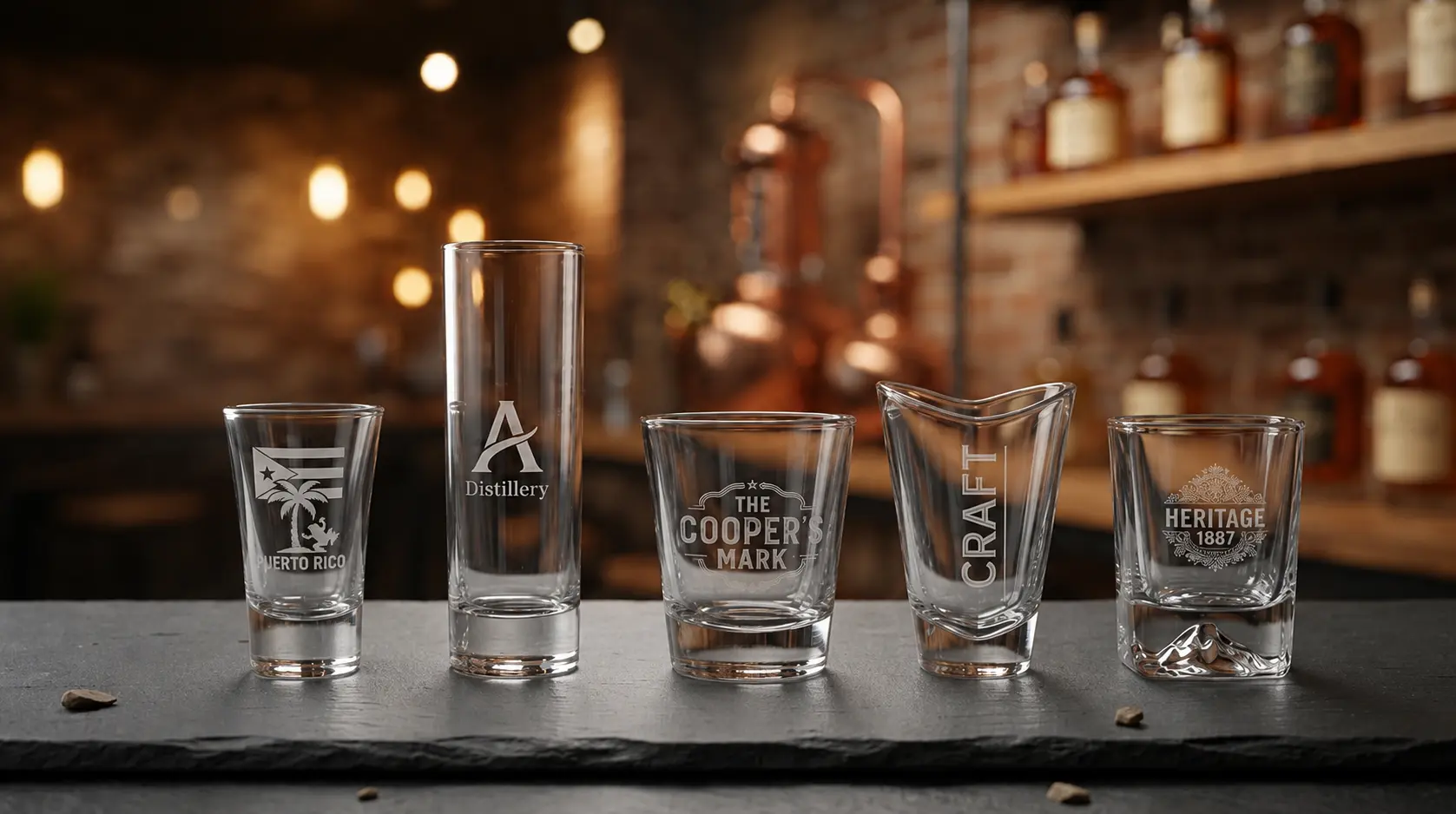
Custom Shot Glasses
Customization is where shot glasses shift from a commodity product to a branded asset, and it’s the area where working with an experienced manufacturer makes the biggest difference in final quality. If you want to elevate your business identity, you can explore our full range of Custom Shot Glasses to see how we bring unique logos and artwork to life.
OEM (Original Equipment Manufacturing): The manufacturer produces glasses to the buyer’s exact specifications, including custom molds, dimensions, and branding — ideal for brand owners who want a fully proprietary product.
ODM (Original Design Manufacturing): The buyer selects from the manufacturer’s existing designs and customizes branding, colors, or finishes — a faster, lower-cost path for importers and wholesalers.
Logo Printing: Screen printing or pad printing applies a brand’s logo directly onto the glass surface, suitable for most standard orders.
Laser Engraving: A permanent, dishwasher-resistant etching method ideal for premium products and personalized gifting lines.
Decal Printing: Applies detailed, multi-color designs via heat-transfer decals, well suited to intricate artwork or photographic-style graphics. You can view our dedicated Decal Printing Shot Glasses catalog to explore the design possibilities.
Frosted Finish: A matte, semi-opaque surface treatment that adds a premium visual texture and pairs well with printed or engraved logos. Explore our complete range of Sandblasted, Frosted & Acid Etched Shot Glasses to find the perfect tactile style for your brand.
Colored Glass: Custom tinted glass bodies allow brand owners to match specific color palettes for retail shelf differentiation.
Custom Packaging: Branded boxes, inserts, and retail-ready packaging that reinforce brand identity from the shelf to the customer’s home.
Private Label: Full white-label production allowing brand owners to sell finished products under their own name with no visible ties to the manufacturer.
For brand owners and spirits companies, OEM production with laser engraving or frosted finishes tends to deliver the most premium, differentiated result. For importers and wholesalers working with tighter margins and faster turnaround needs, ODM with logo printing offers a practical balance of customization and cost efficiency. Promotional product companies and gift suppliers often benefit most from decal printing, which handles detailed, colorful artwork well at moderate cost.

Wholesale Buying Guide
Sourcing shot glasses at scale involves more than picking a design. These are the practical factors that determine whether a wholesale order goes smoothly or turns into a logistics headache.
MOQ (Minimum Order Quantity): Most manufacturers set MOQs based on mold costs and production efficiency; custom molds typically require higher MOQs than decorating existing stock designs.
Lead Time: Standard decorated orders often take a few weeks to produce, while custom mold development adds significant additional lead time — always confirm this before committing to a launch date.*Packaging:* Confirm whether pricing includes bulk carton packing, individual gift boxes, or retail-ready display packaging, since this significantly affects landed cost.
Shipping: Glassware is heavy and fragile, so buyers should clarify whether the manufacturer handles export packaging standards suited to ocean freight, not just domestic transport.
Quality Inspection: Ask whether the manufacturer offers third-party inspection or provides inspection reports before shipment, especially for first-time orders.
Choosing a Reliable Manufacturer: Look for suppliers with verifiable production facilities, clear communication, and a track record of consistent export quality — not just the lowest quoted price.
Importing from China: Many custom shot glasses are produced in China’s established glassware manufacturing regions; buyers should factor in import duties, HTS classification, and freight costs when comparing supplier quotes.
Practical tips for first-time wholesale buyers:
* Always request a physical sample before committing to a full production run.
* Confirm color and print Pantone matching in writing to avoid batch-to-batch inconsistency.
* Ask for a pre-shipment inspection report, particularly for large ocean freight orders.
* Clarify ICC Incoterms Rules (such as FOB or CIF) early in the negotiation process, since this directly dictates which party bears the shipping risk and drastically affects your total landed cost calculations.
* Build in buffer time for customs clearance, especially during peak shipping seasons.
Conclusion
Shot glasses may be small, but the decisions behind sourcing them — size, material, decoration method, and manufacturing quality — have an outsized impact on brand perception and bottom-line profitability. From understanding standard measurements and material tradeoffs to navigating MOQs and export logistics, buyers who go in informed are far better positioned to avoid costly missteps.
Whether you’re an importer building out a hospitality product line, a brand owner launching a private-label spirits product, or a promotional products company sourcing your next branded giveaway, working with an experienced custom glassware manufacturer makes all the difference. If you’re ready to discuss OEM or ODM production for your next shot glass order, reach out to our team to request samples, pricing, and lead time details tailored to your project.