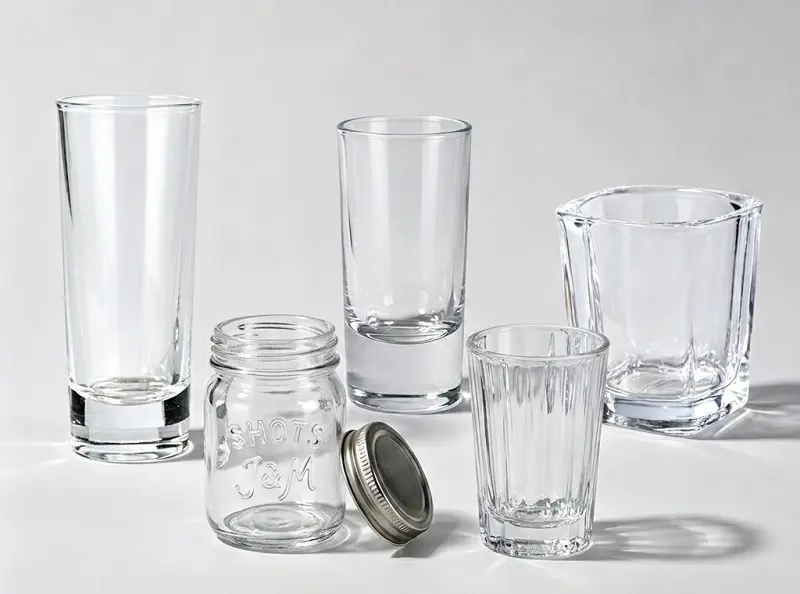

If you import, distribute, or sell drinkware, chances are shot glasses already sit somewhere on your product list — either as a standalone SKU or as an add-on to a bigger barware or promotional order. What separates a forgettable order from a repeat customer is almost always the same thing: how the glass is customized, and who made it.
This guide walks through everything a buyer needs to know before placing a bulk order — glass types, printing methods, MOQs, pricing logic, OEM/ODM options, and the questions that actually matter when vetting a manufacturer. It’s written for people who buy shot glasses for a living, not for consumers picking out a housewarming gift.
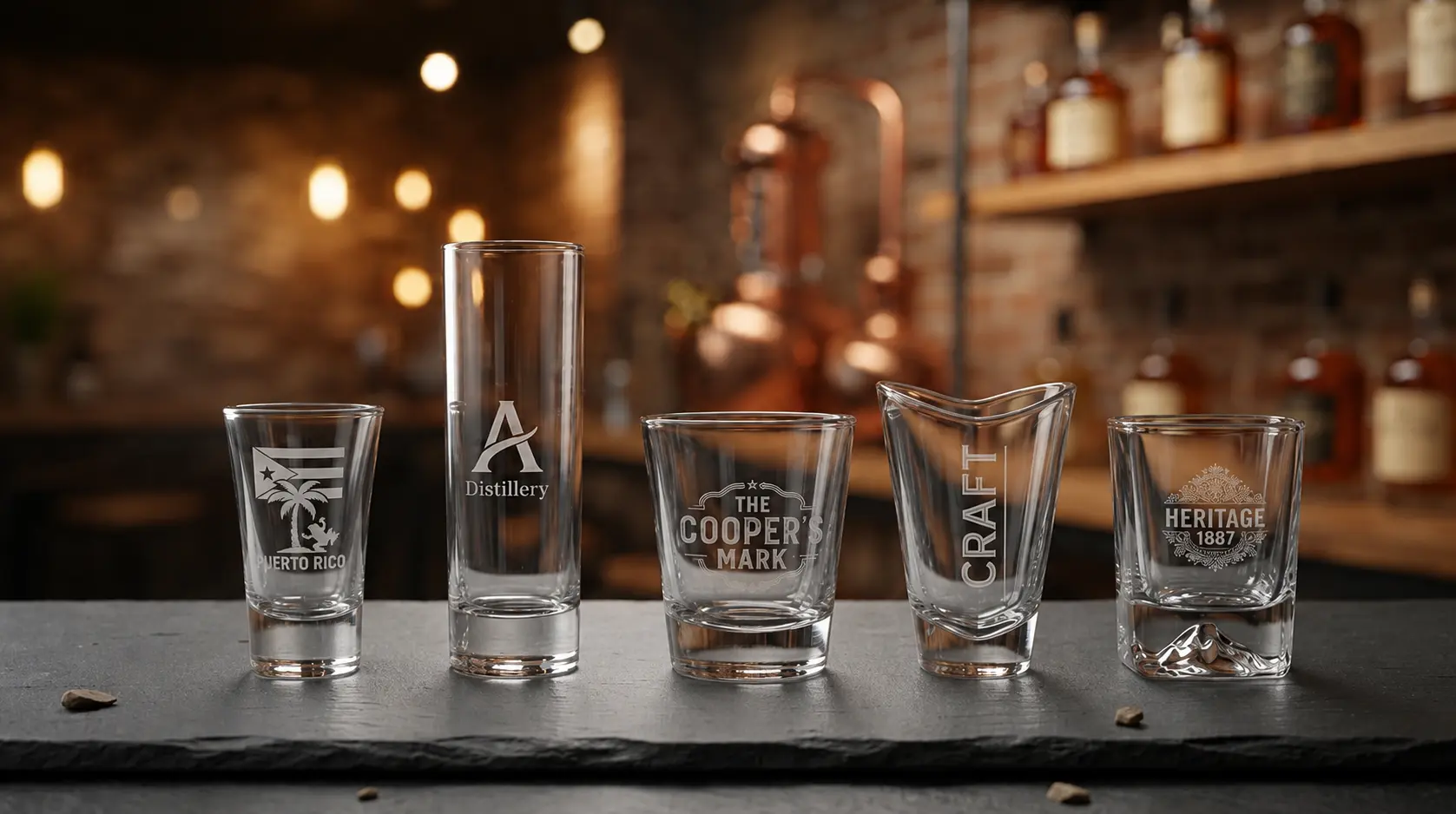
Table of Contents
Table of Contents
- What Are Custom Shot Glasses, and Why Do Buyers Order Them?
- Types of Custom Shot Glasses: Shapes, Sizes, and Materials
- Customization Methods: How to Put Your Logo on a Shot Glass
- The Custom Shot Glass Production Process, Step by Step
- MOQ, Pricing, and Lead Times for Wholesale Orders
- OEM vs. ODM: Choosing the Right Manufacturing Model
- How to Choose a Custom Shot Glass Manufacturer
- Packaging, Compliance, and Shipping Considerations
- Who Buys Custom Shot Glasses — and Why
- Common Mistakes Buyers Make When Ordering Custom Shot Glasses
- FAQ: Custom Shot Glasses
- Request a Quote
What Are Custom Shot Glasses, and Why Do Buyers Order Them?
A custom shot glass is any small-format drinking glass — typically 1 to 2 ounces — that’s been altered from a stock design to carry a brand, message, or decorative element. That could mean a logo screen-printed on the barrel, a distillery name laser-etched into the base, a full-color wraparound decal, or a shape and color developed from scratch for a specific product line. The customization is what turns a commodity item into a branded asset.
For B2B buyers, shot glasses are attractive inventory for a few practical reasons. They’re inexpensive per unit relative to other glassware, they ship densely (more units per carton than tumblers or wine glasses), and they have broad appeal across very different channels — a distillery tasting room, a souvenir shop, a corporate gift box, and a bar’s back-of-house all buy the same basic product for different reasons. That versatility is why shot glasses tend to be one of the first SKUs a new glassware importer tests with a supplier before scaling into beer mugs, whiskey tumblers, or stemware.
Why Businesses Choose Custom Shot Glasses
The purchasing logic varies by industry, but a few drivers show up consistently:
Low unit cost, high perceived value. A well-printed glass with a clean logo reads as a “real” product, not a giveaway, even at a modest price point.
Repeat consumption occasions. Bars restock breakage regularly, distilleries need tasting-room glassware for every visitor, and souvenir shops sell to a constantly rotating customer base — all of which support recurring orders rather than one-time buys.
Brand visibility in social settings. A shot glass photographed at a bar, party, or tasting event functions as passive marketing every time it’s used.
Flexible MOQs relative to other glassware. Because shot glasses are small and mold-compatible across many blanks, manufacturers can often accommodate lower minimums than for large-format glassware.
Strong margins for resellers. Wholesalers and promotional product companies typically mark up branded glassware well above blank glassware, since the design work and brand association add value the raw glass doesn’t have.
Understanding this demand context matters when you’re briefing a factory — a supplier who understands that your shot glasses need to survive commercial dishwashing in a bar setting will spec differently than one packing for a one-time gift box.
Types of Custom Shot Glasses: Shapes, Sizes, and Materials
Not all shot glasses are interchangeable, and the shape, capacity, and glass composition you choose will affect both cost and how the finished product performs in the field. Buyers sourcing for hospitality versus retail gift channels often land on very different specs.
Glass Shapes and Standard Capacities
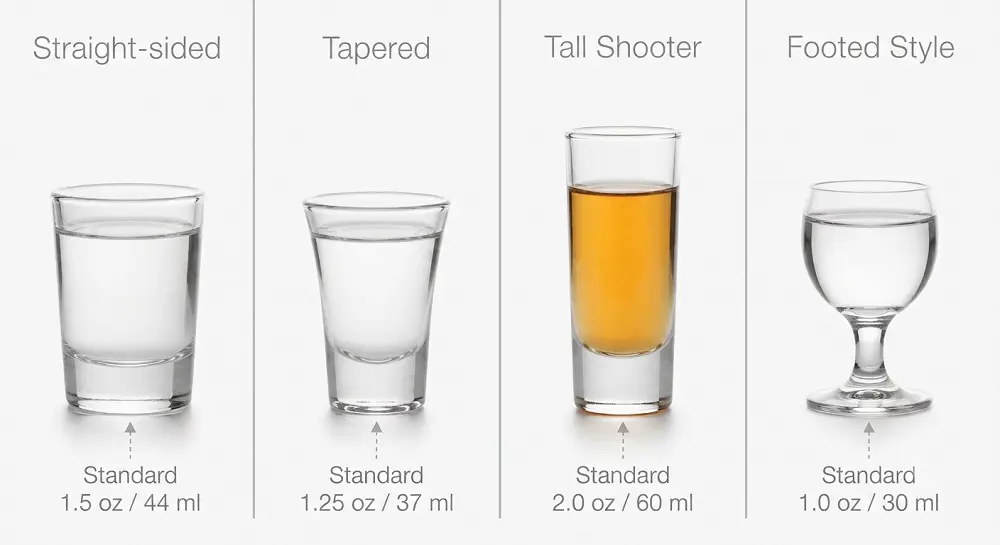
Shape drives both branding surface area and shelf appeal. The most common commercial shapes include:
Straight-sided (tumbler-style)— the most popular shape for logo printing because it offers a flat, uninterrupted surface.
Tapered shot glasses (or fluted)— narrower at the base, flaring slightly at the rim; common in tasting rooms and gift sets.
Barrel or belly shot glasses— rounded mid-section, popular for novelty and souvenir lines.
Tall shooter glasses— featuring a taller, narrower silhouette, these are ideal for layered shots, specialty shooters, or upscale cocktail presentations at commercial bars. Many liquor brands and hospitality distributors source bulk tall shooter glasses specifically for high-end promotional events due to their premium vertical branding surface.
Stemmed or footed shot glasses— used in premium spirits packaging and gift sets to signal a higher price point.
Standard capacities run from around 1 ounce (30 ml) up to 2 ounces (60 ml), with 1.5 ounces (44 ml) being the most common size for U.S. bar pours. Buyers targeting European or Asian markets should confirm local standard pour sizes before finalizing molds, since expectations differ by region.
Material Comparison: Soda-Lime, Crystal, and Borosilicate
The glass formulation affects clarity, weight, durability, and price. Here’s how the three main options compare for commercial buyers:
| Material | Clarity | Durability | Relative Cost | Best For |
|---|---|---|---|---|
| Soda-lime glass | Good | Standard commercial durability | Lowest | Bulk promotional, bars, souvenir retail |
| Lead-free crystal | Excellent, brighter sparkle | Slightly more fragile, thinner walls | Mid to high | Premium spirits gift sets, boutique retail |
| Borosilicate glass | Very good | High thermal shock resistance | Mid to high | Glasses paired with hot infusions or engraving-heavy designs |
Most wholesale and promotional shot glass orders use soda-lime glass — it’s the industry standard for commercial glassware because it balances cost, clarity, and durability well for high-volume use. Lead-free crystal is worth the premium for liquor brands building a top-shelf gift line, where the extra sparkle and weight communicate quality on a retail shelf. If your buyers ask about lead content or food-contact safety, ask your manufacturer to provide relevant material test reports — reputable factories should be able to share these upon request. Manufacturers supplying the U.S. market should ensure compliance with the FDA’s Food Ingredients & Packaging safety standards for food-contact materials, while those exporting to Europe may need to meet EU Regulation (EC) No. 1935/2004 or other local requirements.
Customization Methods: How to Put Your Logo on a Shot Glass
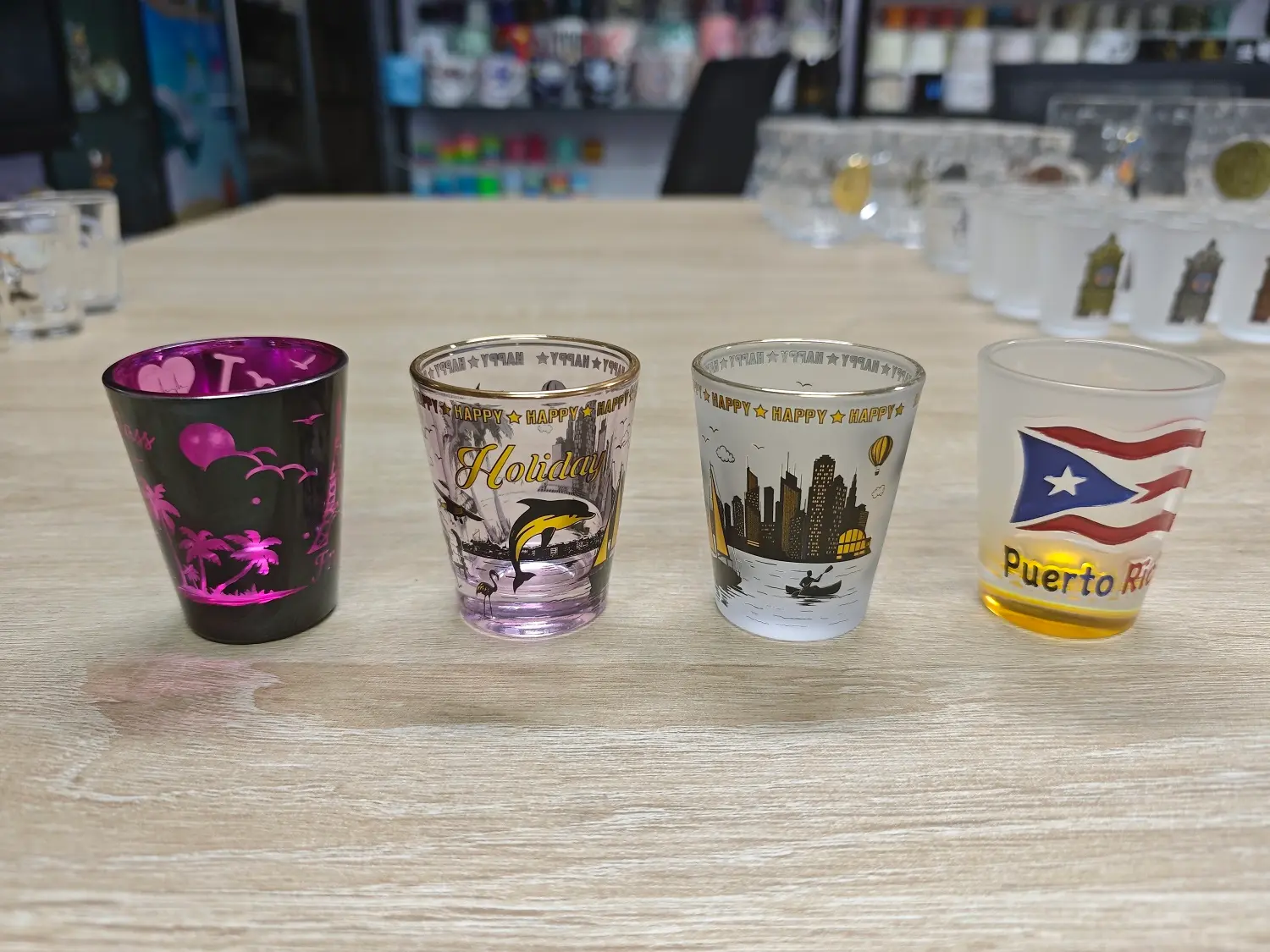
The decoration method you choose affects durability, color range, minimum order quantity, and unit cost — and it’s usually the single biggest factor separating a cheap-looking promotional item from a glass a bar or liquor brand is proud to put on the counter. There’s no universally “best” method; the right choice depends on your budget, order size, and how the glass will be used.
Screen Printing
Screen printing applies ink through a mesh stencil, one color layer at a time, and is the most common decoration method for bulk shot glass orders. It produces bold, opaque colors — including white ink on dark or colored glass — and holds up well to repeated handwashing. Most factories can screen print 1–4 colors cost-effectively; beyond that, per-color setup costs start adding up. Screen printing is the default recommendation for logo-heavy, single- to few-color branding at commercial volumes, which covers the majority of bar, liquor brand, and promotional orders.
Laser Engraving
Laser engraving etches the design directly into the glass surface rather than applying ink on top of it.
There’s no color, but the result is permanent, dishwasher-safe indefinitely, and reads as premium — it’s the preferred method for laser engraved corporate gifts, wedding favors, and personalized spirits packaging where the buyer wants a name, date, or fine-line logo that won’t wear off. Engraving works best with simple line art and text; very fine gradients or photographic detail don’t translate well to etched glass.
Decal and UV Printing
Decal printing and custom transfer services allow for full-color, photo-realistic designs that screen printing cannot achieve economically. This process, along with UV digital printing, is highly useful for gradient logos, illustrated artwork, or complex multi-color branding. UV printing in particular has become more common for shorter runs since it doesn’t require screens, making it more flexible for small-batch or multi-SKU orders. The tradeoff is generally a higher per-unit cost and, depending on the ink system, sometimes less abrasion resistance than traditional methods—always ask your supplier about the dishwasher-safety rating of their specific UV ink and curing process.
Frosting, Color Spray, and Electroplating
Acid-etched frosting — gives the glass a matte, translucent finish, often used as a backdrop for a printed or engraved logo.
Color spray coating — coats the exterior in a solid color (black, gold, copper, etc.) that can then be printed or engraved over.
Electroplating — applies a metallic finish (gold, silver, or copper) for a premium, mirror-like aesthetic. Opting for an electroplating shot glass is a popular choice for high-end liquor gift sets and commemorative brand launches. This luxury coating immediately elevates the product’s perceived retail value on shelves, making it a favorite for distilleries and upscale hospitality distributors looking to source distinctive, top-shelf barware.
These treatments are typically combined with one of the printing or engraving methods above rather than used alone, and they meaningfully change both the shelf presence and the unit cost.
Comparison: Which Decoration Method Fits Your Order?
| Method | Color Range | Durability | Typical MOQ Fit | Best Use Case |
|---|---|---|---|---|
| Screen printing | 1–4 spot colors, incl. white | High, dishwasher-safe | Bulk orders | Bar logos, liquor brands, promo items |
| Laser engraving | None (etched only) | Permanent | Small to mid orders | Corporate gifts, personalization, weddings |
| Decal/UV printing | Full color, gradients | Medium–high (varies by ink) | Small to mid orders | Photo-realistic or multi-color artwork |
| Frosting + print | Depends on combo | High | Mid to bulk orders | Premium retail, gift sets |
| Electroplating | Metallic tones | High | Mid to bulk orders | Luxury spirits packaging |
The Custom Shot Glass Production Process, Step by Step
Understanding how your order actually moves through a factory helps you ask better questions, catch problems earlier, and set realistic timelines with your own customers.
1. Design and file preparation.You submit artwork (vector files are strongly preferred — AI, EPS, or PDF) along with Pantone color references. A competent manufacturer will flag anything unprintable before proceeding, such as gradients specified for screen printing.
2. Digital proof approval. The factory sends a rendered mockup showing logo placement, size, and color for sign-off. This is the stage to catch positioning issues — not after the sample run.
3. Sample production. A small batch (often 5–20 pieces) is produced using the actual glass blank and decoration method you’ll use in bulk. Buyers should always request physical samples, not just digital proofs, before committing to a full production run.
4. Sample approval and mold/tooling confirmation. If you’re doing a custom shape rather than a stock blank, this is also when tooling is finalized — a step that adds lead time and typically requires a separate tooling investment.
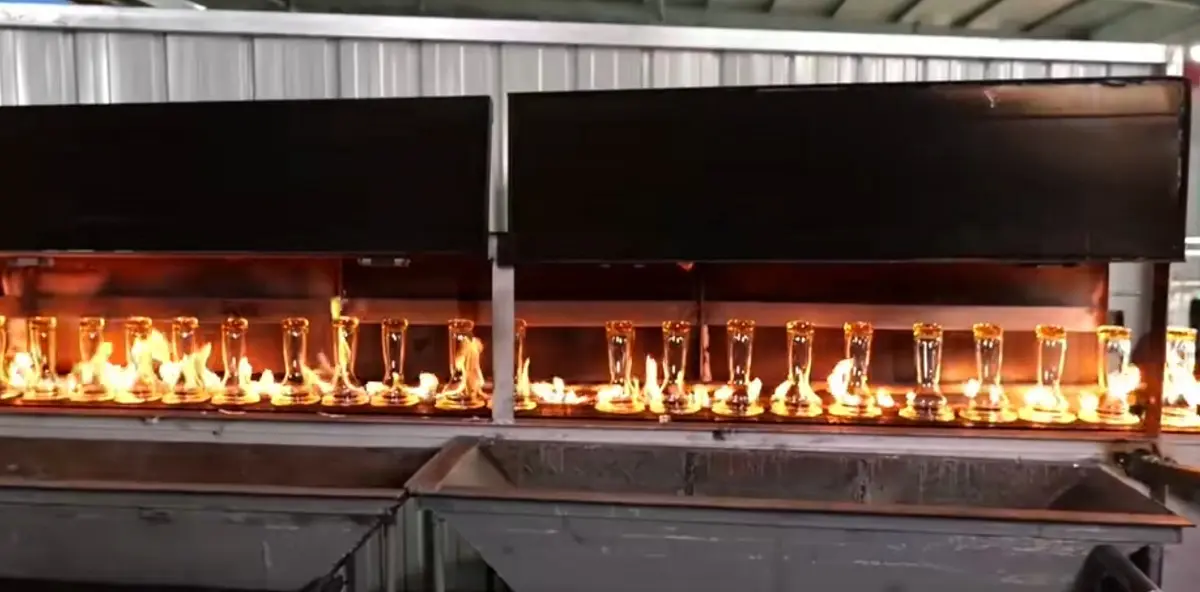
5. Bulk production. Glass blanks are decorated in batches, cured (for printed inks, this usually involves a kiln-fired or oven-cured process to bond the ink to the glass), and quality-checked.
6. Quality inspection. Reputable factories run in-line checks during production and a final inspection before packing — checking for print registration, color consistency, glass defects (bubbles, chips, uneven rims), and dimensional accuracy.
7. Packaging and export preparation. Glasses are packed per your specification (individual boxes, bulk cartons, gift sets), labeled, and prepared with the documentation needed for customs clearance.
8. Shipping. Sea freight for full container loads, air freight for urgent or smaller orders, and consolidated freight for mixed-SKU shipments are the typical options.
A realistic total timeline — from confirmed artwork to cargo-ready goods — usually runs several weeks for standard blanks with screen printing, and longer for custom mold development. Always get a written production timeline from your supplier rather than assuming a standard schedule; capacity varies by season and order volume.
MOQ, Pricing, and Lead Times for Wholesale Orders
Minimum order quantities and pricing are usually the first two questions buyers ask — and the answers depend on more variables than most people expect going in.
Factors That Affect Pricing
Several inputs stack together to determine your final landed cost per unit:
Glass blank type — stock blanks are cheapest; custom-shaped molds require tooling investment, usually amortized into a higher per-unit cost or a separate one-time fee.
Decoration method — screen printing is generally the most cost-effective per unit at volume; engraving, UV printing, and multi-step finishes (frosting + print, electroplating) cost more.
Number of colors — each additional screen-printed color adds a setup charge and production step.
Order volume — pricing typically breaks into tiers, with meaningful cost drops at higher quantities due to setup costs being spread across more units.
Packaging complexity — individual gift boxes, inserts, and custom carton printing all add cost versus standard bulk cartons.
Glass material — crystal and specialty finishes cost more than standard soda-lime glass.
Because these variables interact, it’s difficult to quote an accurate per-unit price without knowing your specific glass type, decoration method, color count, and volume — treat any generic “starting from $X” figure you see online as a rough anchor, not a quote you can plan around.
Typical MOQ Ranges by Order Type
| Order Type | Typical MOQ Range | Notes |
|---|---|---|
| Stock blank + screen print (1–2 colors) | Lower MOQ, most accessible | Fastest turnaround, most economical |
| Stock blank + engraving | Low to moderate MOQ | Popular for gifting and personalization |
| Stock blank + multi-color/UV print | Moderate MOQ | Higher per-unit cost |
| Custom mold/shape | Higher MOQ | Tooling cost typically applies |
| Mixed-SKU sample or trial orders | Case-by-case | Many manufacturers offer small trial runs for new buyers |
If your projected volume is genuinely lower than a factory’s standard MOQ, it’s worth asking directly rather than assuming you’re locked out — many manufacturers will accommodate a smaller first order to build the relationship, sometimes with a modest surcharge, especially for buyers who can show a credible path to reorders.
OEM vs. ODM: Choosing the Right Manufacturing Model
For buyers newer to glassware sourcing, the OEM/ODM distinction determines how much design control — and design responsibility — sits with you versus the factory.
OEM (Original Equipment Manufacturer) means you supply the design, and the factory manufactures to your spec — your logo, your color, your packaging, built on either a stock or custom glass shape. This is the right model when you already have brand guidelines and simply need production capacity.
ODM (Original Design Manufacturer) means the factory contributes design development — shape, decoration concept, or full product design — which you then brand and sell as your own. This is useful for buyers who know their target market but don’t have in-house glassware design expertise, or who want a differentiated shape without investing in mold development from scratch.
| Factor | OEM | ODM |
|---|---|---|
| Who designs the product | Buyer | Manufacturer (often collaboratively refined with buyer input) |
| Best for | Established brands with existing design assets | Buyers wanting a unique product without full in-house design |
| Speed to market | Faster if artwork is print-ready | Slightly longer due to design development |
| Differentiation | Depends entirely on buyer’s design | Manufacturer may offer proprietary or semi-exclusive shapes |
| Typical buyer profile | Liquor brands, established promo companies | Gift companies, souvenir retailers, new importers |
Many buyers actually use a hybrid approach in practice — starting with an ODM base shape the factory already has in development, then applying full OEM-level branding and packaging on top of it. This gets you a distinctive product without the cost and lead time of ground-up mold development. It’s worth asking any manufacturer you’re evaluating what existing ODM shapes they have in their catalog before committing to a fully custom mold.
How to Choose a Custom Shot Glass Manufacturer
The manufacturer you choose affects far more than unit price — it affects your defect rate, your ability to hit reorder deadlines, and how much hand-holding each order requires. A few criteria matter more than others when vetting suppliers.
Specialization in glassware, not a general houseware trading company that subcontracts glass production out. Manufacturers with dedicated glass production lines typically have tighter quality control over things like wall thickness consistency and rim finishing.
In-house decoration capability. A factory that does printing, engraving, and finishing on-site (rather than outsourcing decoration to a third party) generally offers better quality control and faster turnaround.
Transparent sample and proofing process. Ask specifically whether physical pre-production samples are standard practice, not optional.
Export experience with your target market. A supplier familiar with U.S., EU, or other destination-market packaging and compliance norms will save you rework.
Willingness to share documentation. Reasonable requests — material composition, relevant test reports, production capacity, factory audit reports — should be answerable without resistance. Be cautious of any supplier unwilling to provide verifiable documentation for claims they make.
Questions to Ask Before You Place an Order
Before committing budget to a new supplier relationship, get clear answers to these:
– What is the MOQ per SKU, and does it change with a mixed-color or mixed-design order?
– What decoration methods are done in-house versus outsourced?
– What is the standard production lead time, and how does that change during peak season?
– Can you provide a physical pre-production sample, and what does that cost?
– What is your defect rate policy — how are breakage and print defects handled contractually?
– Do you offer packaging customization (gift boxes, foam inserts, barcode labeling)?
– What Incoterms do you support (FOB, EXW, CIF), and who arranges freight?
– Can you share relevant compliance or material test documentation for the destination market?
A supplier who answers these clearly and specifically — rather than vaguely — is generally a stronger long-term partner than one offering only the lowest quoted price.
Packaging, Compliance, and Shipping Considerations
Packaging is often an afterthought in early sourcing conversations, but it has a direct effect on breakage rates, customs clearance, and how your product performs on a retail or bar shelf.
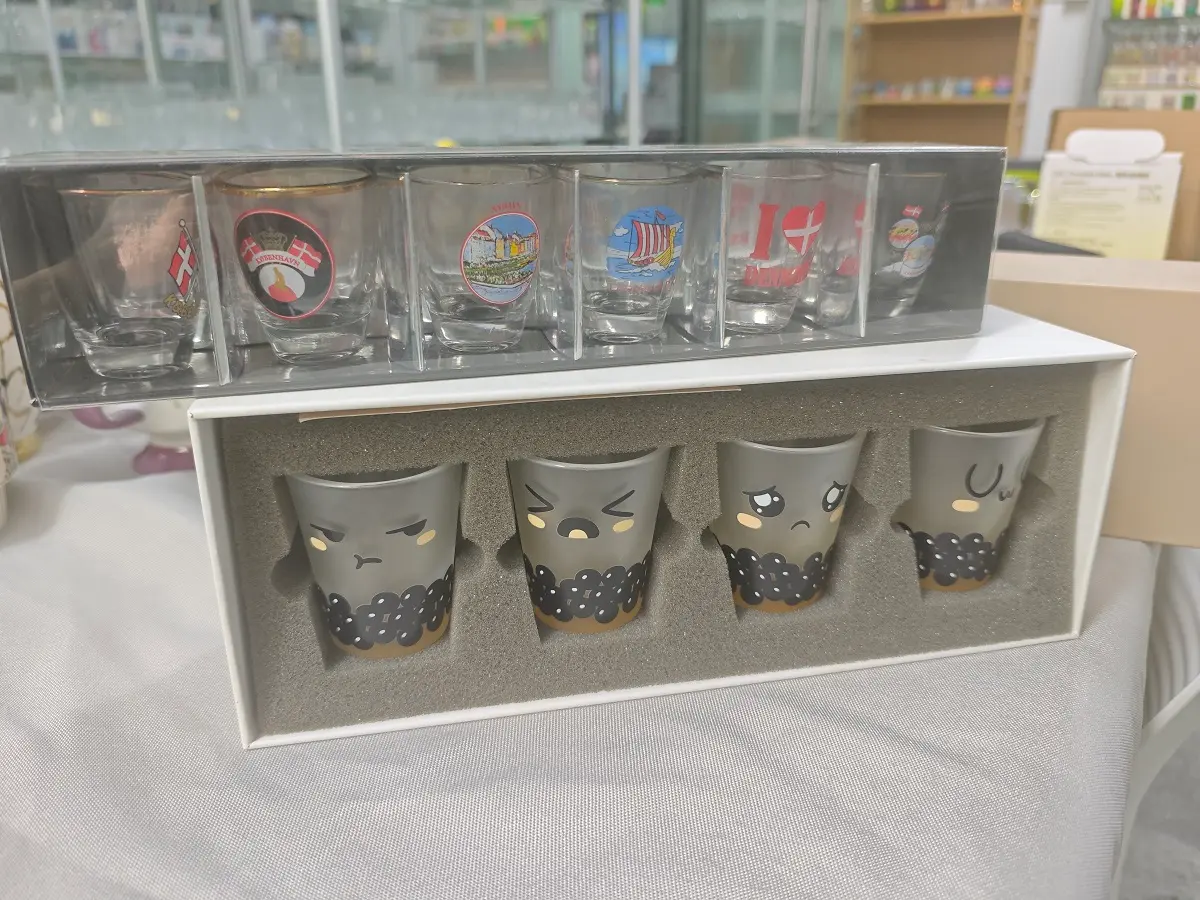
For bulk B2B orders, standard export packaging usually involves individual glasses wrapped or cushioned, packed into partitioned inner cartons, then master cartons rated for the shipping method (sea freight cartons generally need to withstand more handling stress than air freight). If your end customer is retail-facing — a souvenir shop or gift channel — you’ll likely also need individual gift boxes, printed sleeves, or branded inserts, which should be specified and costed at the quoting stage, not added afterward.
Compliance requirements vary by destination market and by what the glass will contact (spirits versus decorative use only). Buyers importing into the U.S. or EU should confirm with their supplier what food-contact material documentation is available, and independently verify current requirements with the relevant regulatory body rather than relying solely on supplier claims — the FDA’s food contact substance guidance and the EU’s EC 1935/2004 framework are useful starting references. Buyers reselling under their own brand should also confirm labeling requirements for their specific market (country of origin marking, recycling symbols, etc.), since these obligations typically fall on the importer of record, not the factory.
On freight, most bulk glassware moves by sea freight in full or shared containers for cost efficiency, with air freight reserved for urgent restocks or sample shipments given the weight and breakage sensitivity of glass. Ask your supplier for their standard export carton drop-test or handling practices — glass breakage during transit is one of the most common and most avoidable issues in this category, and a supplier with a defined packaging protocol will generally have a materially lower damage rate than one packing to a generic standard.
Before finalizing logistics, commercial importers must pay close attention to local regional requirements. For instance, ensuring your shipment is classified under the proper tariff lines using the official USITC HTS Chapter 70 Glassware PDF Document is critical for accurate customs clearance.
Who Buys Custom Shot Glasses — and Why
Different buyer types use the same core product for different commercial purposes, which is worth understanding if you’re deciding how to position your own resale offering.
Liquor and spirits brands use custom shot glasses primarily for tasting rooms, brand activations, and premium gift-with-purchase packaging — decoration quality and glass weight tend to matter more here than absolute unit price, since the glass is part of the brand experience.
Bar and hospitality suppliers prioritize durability and consistent sizing above all else, since these glasses go through repeated commercial dishwashing cycles and need to survive daily handling — soda-lime glass with screen-printed logos is the practical default for this segment.
Promotional product companies and gift companies typically need faster turnaround, moderate MOQs, and flexible design turnaround across many different client logos, which makes screen printing and UV printing the most common methods in this channel.
Souvenir retailers lean toward decorative, novelty shapes and full-color printing, often prioritizing shelf appeal and price point over industrial-grade durability.
Importers and wholesalers generally care most about landed cost, consistent quality across reorders, and a manufacturer who can scale volume without quality drift — for this group, the manufacturer relationship matters more than any single order.
Recognizing which of these profiles you’re serving (or which you resemble as a buyer) helps you brief your manufacturer accurately and avoid over- or under-specifying quality for your actual use case.
Common Mistakes Buyers Make When Ordering Custom Shot Glasses
A few avoidable errors show up repeatedly among first-time and even experienced glassware buyers:
– Skipping the physical sample stage. A digital proof can’t show you actual color rendering on glass, print durability, or glass weight — always request a physical sample before bulk production.
– Underspecifying the decoration method for the use case. A bar-bound glass decorated with a low-durability print method will fail fast under commercial dishwashing; match the method to how the glass will actually be used.
– Not confirming tooling costs upfront for custom shapes. Mold development costs can be substantial and are sometimes quoted separately from per-unit pricing — get this in writing before approving a custom shape.
– Ignoring packaging until late in the process. Retrofitting gift boxes or export cartons after production is finalized often costs more and delays shipping.
– Choosing a supplier on price alone. The cheapest quoted unit price can be offset entirely by a high defect rate, slow communication, or unreliable lead times — total cost of ownership matters more than the line-item price.
– Not clarifying Incoterms and who owns freight risk. Confusion over FOB versus EXW versus CIF terms is a common source of disputes and unexpected costs.
– Assuming all “custom” means the same thing. Ask specifically whether “custom” refers to logo decoration on a stock glass or a fully custom mold — these are very different projects with very different timelines and costs.
FAQ: Custom Shot Glasses
1. What is the minimum order quantity for custom shot glasses?
The Minimum Order Quantity (MOQ) depends largely on the chosen branding method and whether the project utilizes stock blanks or custom-molded glass. Here is a baseline reference for commercial orders:
Screen Printing: When utilizing standard stock blanks, the MOQ is typically lower and highly accessible. However, if a project requires a proprietary custom-engineered mold, a significantly higher volume is required to offset the initial tooling and setup costs.
Decal / UV Printing: Because these digital and transfer methods require no custom physical tooling, the entry barrier is substantially lower. While industry averages for wholesale glassware typically require thousands of units, our facility proudly accommodates flexible low-volume production starting at just 144 pieces per run to support growing brands.
2. How much do custom shot glasses cost wholesale?
Per-unit pricing depends on glass material, decoration method, number of colors, order volume, and packaging complexity. Because these variables interact, it’s best to request a formal quote based on your specific spec rather than relying on general pricing ranges found online.
3. What’s the best printing method for a logo on a shot glass?
For most bulk, bar-facing, or promotional orders, screen printing offers the best balance of durability and cost. Laser engraving is better for permanent, colorless personalization (names, dates, fine text). Full-color or gradient logos generally need UV or decal printing.
4. Can I get a sample before placing a bulk order?
Yes — and you should always insist on it. Reputable manufacturers offer physical pre-production samples so you can verify glass quality, color accuracy, and print durability before committing to a full run. Confirm sample cost and lead time upfront.
5. Are custom shot glasses dishwasher safe?
Dishwasher durability depends entirely on the chosen branding method, the ink quality, and the curing process utilized during manufacturing. Generally, screen printing, laser engraving, and high-temperature kiln-fired decals offer the best resistance to commercial dishwashing cycles.
6. What’s the difference between OEM and ODM shot glass manufacturing?
OEM means you provide the design and the factory manufactures to your spec. ODM means the manufacturer contributes design development, which you then brand as your own. Many buyers use a hybrid of both — starting from an existing manufacturer shape and applying custom branding.
7. How long does production take for a bulk custom shot glass order?
Timelines vary by decoration complexity, order volume, and whether custom tooling is involved. Standard blanks with screen printing are typically faster than custom molds or multi-step finishes. Always request a written production timeline specific to your order rather than assuming a fixed industry standard.
8. Can shot glasses be made with lead-free crystal for a premium product line?
Yes — lead-free crystal is a common choice for premium liquor gift sets and boutique retail, offering better clarity and a heavier feel than standard soda-lime glass, at a higher price point.
9. Do I need special compliance documentation to import custom glassware?
Requirements vary by destination market and end use. Buyers importing into the U.S. or EU should confirm food-contact material documentation with their supplier and independently verify current requirements with the relevant regulatory authority, since import compliance obligations typically rest with the importer of record.
10. Can a manufacturer produce a fully custom shot glass shape, not just a custom logo?
Yes, this falls under custom mold development (closer to the ODM/full-custom end of the spectrum). It requires a tooling investment and longer lead time than decorating a stock blank, so it’s usually reserved for buyers with sufficient volume to justify the cost.
Request a Quote
If you’re evaluating suppliers for custom, personalized, or bulk wholesale shot glasses — whether that’s a straightforward logo print run or a fully custom mold and finish — the fastest way to get accurate numbers is a direct quote based on your actual specs: glass type, decoration method, quantity, and packaging requirements.
As an OEM & ODM glassware manufacturer with over 15 years of experience producing shot glasses, beer glasses, whiskey glasses, and wine glasses for importers, wholesalers, liquor brands, and hospitality buyers worldwide, we’re happy to walk through your project, send physical samples, and provide a detailed quotation with no obligation.
Get in touch today to request your custom shot glass quote and sample.